
RiseCert

RiseScore
How AI-fluent are you, really? Free · Get your RiseScore and a shareable badge How it works
Begin Assessment

Prompt Writing Fundamentals

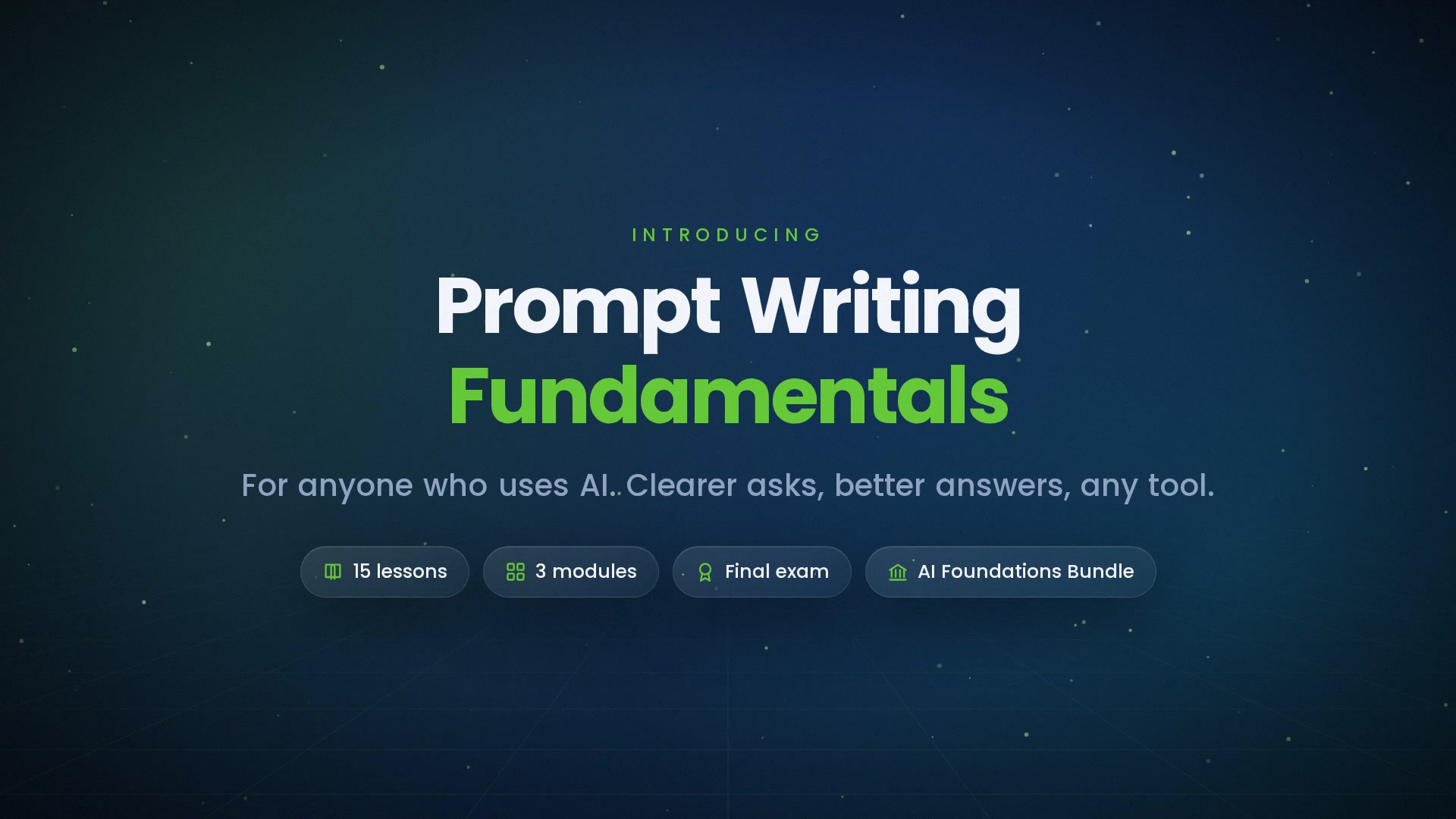
The quality of what you get from an AI tool depends almost entirely on what you ask for. This course teaches the single highest-leverage AI skill: writing clear prompts with real context, a defined output, and smart follow-ups. You'll learn a simple four-part structure, practical techniques like roles and step-by-step requests, and how to check output before you rely on it. By the end, you'll have a personal prompt library and a habit that works in any AI tool.
Certificate included
Video preview
Course details
Duration 57m 43s
Lectures 15
Video 1 hour
Quizzes 1
Level Beginner

Course Description

Two people can use the same AI tool and get completely different results. The difference is the prompt. This course moves you from typing search-style questions to writing clear briefs that produce useful output, and shows you how to fix a weak result quickly instead of starting over.

What you'll learn

  • The four-part anatomy of a strong prompt, and the context a tool can't see on its own
  • How to set the standard with examples, tone, length, and structure
  • Iterating without restarting, using roles, and breaking big requests into steps
  • Getting tables, templates, and formulas you can actually use
  • Prompts that reduce invented facts and keep sensitive data out of the tool
  • Building a reusable prompt library you can share with your team

Who it's for

Any professional who uses, or is about to use, a chat assistant or built-in AI copilot at work. No technical background required.

15 short video lessons in three modules: How Prompts Work, Techniques That Work, and Prompts at Work.

Module 1: How Prompts Work
Module 2: Techniques That Work
Module 3: Prompts at Work

Learn at your own pace

Study the materials at your convenience, you can always return to them to repeat

RiseCert illustration: Course structure: 3 modules of 5 lessons, 15 of 15 lit

Certificate of completion

Complete every lesson and pass the final exam to earn a RiseCert certificate of completion you can download and share.

RiseCert certificate of completion background

Your Name

Prompt Writing Fundamentals

RISECERT

CERTIFICATE

For demonstrated knowledge and successful completion of all course requirements for:

MM.DD.YYYY

Certificate Date

Ready to get started?

Enroll in Prompt Writing Fundamentals and earn your RiseCert certificate of completion.

Certificate included

Got Questions? We've Got Answers!

Answers to the most common questions about this course.

What is the Prompt Writing Fundamentals course?
Prompt Writing Fundamentals is a RiseCert online course that teaches professionals how to write AI prompts that return usable output: a four-part prompt structure, the context a tool can't see, follow-ups that fix a draft instead of restarting, and checks before you rely on the result. It includes 15 video lessons (about an hour) and a final exam.
Who should take a prompt writing course?
Any professional who uses, or is about to use, a chat assistant or a built-in AI copilot at work: managers, analysts, coordinators, assistants, and anyone who writes emails, summaries, reports, or plans. Prompt Writing Fundamentals is also useful for team leads who want a shared prompt library and a consistent way of working with AI.
What makes a good AI prompt?
A good prompt is a brief, not a search. Prompt Writing Fundamentals teaches four parts: a task with one clear verb, context the tool can't see (who it's for and why), a format for the output, and constraints such as length, tone, and what to leave out. Complete prompts are rarely longer than three sentences.
Why do AI tools give generic answers?
An AI assistant predicts the most likely helpful response to your exact words, so anything you leave out gets filled with an average guess. Keyword-style prompts produce generic drafts. The course shows how naming the reader, purpose, format, and limits narrows that guess, and how to diagnose which part of a prompt was missing when output disappoints.
How can I get AI tools to stop making up facts?
Restrict the source and give the tool permission not to know. The course teaches phrasing such as "using only the document I pasted" and "if it isn't there, say not stated." It also covers the signs of an invented fact, like a precise figure you never supplied, and the rule to verify at the source or cut it.
What is a prompt library?
A prompt library is a small, organized collection of prompts that worked, saved for reuse. In Prompt Writing Fundamentals you learn to strip specifics into bracketed placeholders, name each prompt by task, save the best output as an example, keep about 10 to 20 entries, and share prompts with your team along with a note on when each one fits.
Do I need technical skills or coding experience to take the course?
No. Prompt Writing Fundamentals requires no technical background. The course treats prompting as the same skill as briefing a capable colleague, explained in plain language with everyday work examples. One lesson covers requesting spreadsheet formulas and small code snippets, but it focuses on asking for an explanation and testing results, not on programming.
What will I be able to do after completing the course?
You'll be able to write complete four-part prompts, set the standard with an example, read AI drafts critically, refine them with keep-and-change follow-ups, use roles that change the output, break big requests into steps, get tables and templates you can paste, reduce invented facts, and keep sensitive data out. You'll also start a personal prompt library.
Which AI tools does Prompt Writing Fundamentals work with?
The course is tool-agnostic. Its techniques apply to general chat assistants and to AI copilots built into email, document, and spreadsheet apps, because they all respond to the same briefing principles. No specific product is required or endorsed; use whichever tools your employer has approved, and follow its data policy.
How is this different from a list of prompt templates or tricks?
Template lists give you prompts to copy. Prompt Writing Fundamentals teaches why prompts work, so you can write and fix your own for any task: the four-part structure, how to diagnose a weak result, how to iterate without restarting, and when a technique like a role is useful versus decorative. You then build your own reusable library.
Does the course cover what not to paste into an AI tool?
Yes. A dedicated lesson teaches a ten-second check before pasting: personal data, credentials, confidential business information, and anything regulated or under a non-disclosure agreement stay out. The course shows how to replace names and figures with placeholders so the prompt still works, or to use your company's approved tool and check its data policy.
How long does the Prompt Writing Fundamentals course take?
The course has about an hour of video across 15 lessons, plus a final exam. Lessons run a few minutes each and are organized into three modules: How Prompts Work, Techniques That Work, and Prompts at Work. Most learners can finish in one or two sittings and start a five-day practice plan the next day.
Is the course online and self-paced?
Yes. Prompt Writing Fundamentals is 100% online and self-paced, and your access does not expire. You can start, pause, and resume at any time on a computer, tablet, or phone with a modern web browser. There's nothing to install, and you can revisit lessons whenever you need a refresher.
Is there a final exam?
Yes. The course ends with a 30-question multiple-choice final exam covering all three modules. You need a score of 80% or higher (24 of 30) to pass, and you can retake the exam as many times as you need. Complete all 15 lessons and pass the exam to finish the course.
Do I get a certificate of completion?
Yes. After you complete all 15 lessons and pass the final exam, you can download a RiseCert certificate of completion for Prompt Writing Fundamentals. It is a course completion certificate, not a license, a professional certification, or a continuing education (CE) certificate.
Does the course count for continuing education (CE) credit?
No. Prompt Writing Fundamentals is not currently approved or accredited for continuing education credit (CE, CPE, or CEU) by any state, licensing body, or professional association. If you need credit hours for a license or certification, take a course approved by the body that governs your requirement.
Will the techniques still work as AI tools change?
The course teaches durable briefing habits rather than features of one product: giving context, stating format and limits, showing an example, reading output critically, and following up. These principles apply across assistants and copilots, so they carry over as tools are updated or replaced. Always check your specific tool's settings and your company's policy.
How much does the course cost, and can I enroll my team?
Prompt Writing Fundamentals costs $99 per learner as a one-time purchase, with no subscription or recurring fees. To enroll a team or department, contact RiseCert through the Contact Us page at risecert.org, and the team can build a shared prompt library together.
What is the refund policy?
All sales are final and no refunds are issued, as stated in the RiseCert Terms of Use. Please review the course description, lesson list, and these FAQs before purchasing Prompt Writing Fundamentals, and contact RiseCert with any questions first.
Is Prompt Writing Fundamentals professional or legal advice?
No. The course is educational and is not legal, compliance, or professional advice. It teaches general prompting practices, but you remain responsible for checking AI output and for anything you send. Your employer's AI policy, approved tools, and data rules govern how you use AI at work.
