
RiseCert

RiseScore
How AI-fluent are you, really? Free · Get your RiseScore and a shareable badge How it works
Begin Assessment

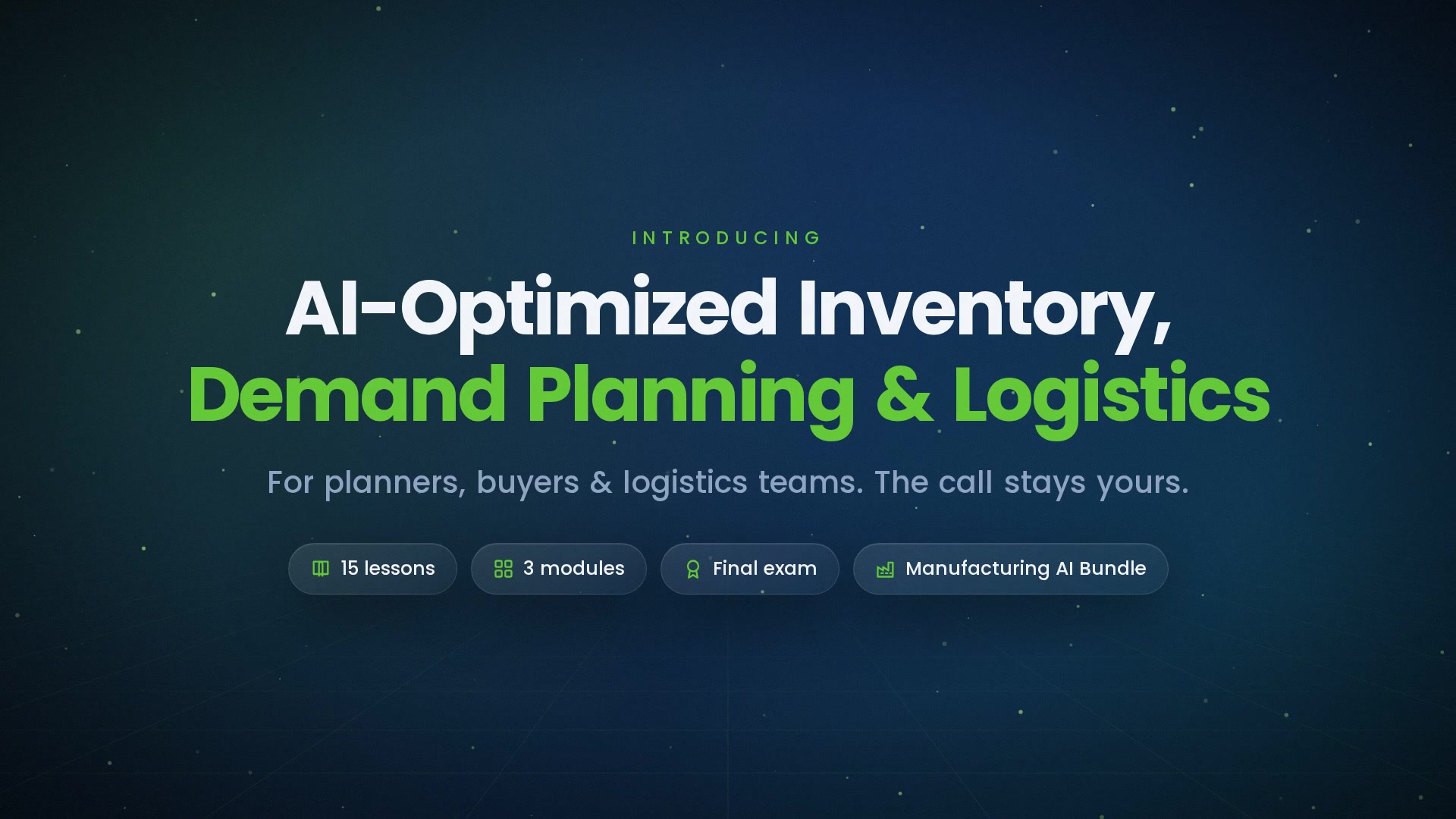
AI-Optimized Inventory, Demand Planning & Logistics

AI now forecasts demand, recommends safety stock and purchase orders, watches supplier risk, and re-plans routes faster than any team could by hand. This course shows planners, buyers, and logistics coordinators how to use those recommendations while keeping the decision, and the record of it, with a person. You'll learn to read forecast error and bias, question service targets, triage supplier signals, review contracts and routes, and measure outcomes against an honest baseline. You'll finish with a one-page planning playbook and a six-line checklist for any recommendation.
Certificate included
Video preview
Course details
Duration 1h 19m 45s
Lectures 15
Video 1.25 hours
Quizzes 1
Level Beginner

Course Description

Every manufacturer lives between two expensive mistakes: too little stock, which stops lines and costs customers, and too much, which ties up cash and ends in write-offs. AI tools now recommend forecasts, buffers, orders, and routes at scale. This course teaches you to know their inputs, own the decision, record the reason, and measure the outcome.

What you'll learn

  • Reading AI demand forecasts, forecast accuracy versus bias, and recording overrides
  • Safety stock, segmented service targets, and learned supplier lead times
  • Cleaning item masters and demand history, and measuring service, inventory, and cost
  • Purchase recommendations, supplier messages, and negotiation prep with the buyer in charge
  • Supply-risk triage, contract review, and fair dealing with confidential supplier data
  • Route and load plans, shipment exceptions, and warehouse tools that respect people

Who it's for

Demand and supply planners, buyers, purchasing managers, logistics coordinators, and warehouse supervisors at manufacturers who use AI recommendations.

15 short video lessons in three modules: Planning; Purchasing and Suppliers; and Logistics.

This course is educational and is not financial, legal, engineering, or safety advice. Qualified professionals, company policy, and applicable regulations govern.

Module 1: Planning
Module 2: Purchasing and Suppliers
Module 3: Logistics

Learn at your own pace

Study the materials at your convenience, you can always return to them to repeat

RiseCert illustration: Course structure: 3 modules of 5 lessons, 15 of 15 lit

Certificate of completion

Complete every lesson and pass the final exam to earn a RiseCert certificate of completion you can download and share.

RiseCert certificate of completion background

Your Name

AI-Optimized Inventory, Demand Planning & Logistics

RISECERT

CERTIFICATE

For demonstrated knowledge and successful completion of all course requirements for:

MM.DD.YYYY

Certificate Date

Ready to get started?

Enroll in AI-Optimized Inventory, Demand Planning & Logistics and earn your RiseCert certificate of completion.

Certificate included

Got Questions? We've Got Answers!

Answers to the most common questions about this course.

What is the AI-Optimized Inventory, Demand Planning & Logistics course?
AI-Optimized Inventory, Demand Planning & Logistics is a RiseCert online course that teaches manufacturing planners, buyers, and logistics staff to use AI forecasts, buffer and purchase recommendations, risk alerts, and route plans while a named person keeps the decision and records the reason. It includes 15 video lessons (about 1 hour 20 minutes) and a final exam.
Who should take an AI supply chain planning course?
Demand and supply planners, inventory analysts, buyers and purchasing managers, logistics coordinators and managers, and warehouse supervisors at manufacturers and distributors. It suits anyone who reviews AI-generated forecasts, safety-stock or purchase recommendations, supplier risk alerts, route and load plans, or labor schedules, and anyone who reports planning results to leadership.
What is the difference between forecast accuracy and forecast bias?
Accuracy measures how far off a forecast was, regardless of direction; bias measures whether it runs consistently high or low. The course explains that persistent bias is the costlier problem, because it quietly builds excess stock or chronic shortages, and that it often comes from human overrides, so bias is tracked for the model and for each person's adjustments.
How does AI calculate safety stock?
An AI safety-stock recommendation prices three uncertainties: demand uncertainty (forecast error), supply uncertainty (lead-time variability), and exposure time (lead time plus review cycle). A service target then sets how much of that uncertainty you cover. The course stresses that the target is a business choice, and the last few points of service cost the most inventory.
When should a planner override an AI recommendation?
When the planner knows something the tool can't see, such as a customer call, a supplier relocation, or a dock constraint. The course teaches overriding with a specific reason code and sentence, keeping both the recommended and chosen numbers, adding an expiry or review date for temporary changes, and reviewing overrides monthly so repeated ones become rule or data fixes.
Can AI review supplier contracts?
AI summarization can extract key terms, flag deviations from your standard, track notice and renewal dates, and compare versions, using approved tools only. The course teaches that a summary is not the contract: price adjustment, delivery, liability, termination, volume, and trade-term clauses always get a full human read, and deviations route to counsel per company policy.
Does the course cover logistics and warehouse operations?
Yes. Module 3 covers route and load optimization, reading predicted arrival times, acting on shipment exceptions, writing customer delay messages, and AI slotting, pick, and labor-planning tools. It teaches that weight limits, load securement, and driver hours are never traded for cost, and that pick targets come from observed work with allowances.
What will I be able to do after completing the course?
You'll be able to review AI forecasts by exception, question service targets, use learned lead times, clean item masters and demand history, accept or override purchase recommendations with a useful record, triage supplier risk, review contracts, check route plans against safety lines, and run your own one-page planning playbook and six-line checklist.
Do I need data science or statistics experience?
No. The course is written for working planners, buyers, and logistics staff, not data scientists. Concepts like forecast bias and service levels are explained in plain language with composite examples, such as a demand spike from distributor buy-aheads and a storm reroute. Familiarity with planning or purchasing work helps, but there are no formal prerequisites.
Which planning or logistics software does the course cover?
None specifically. AI-Optimized Inventory, Demand Planning & Logistics is vendor-neutral and endorses no product. It covers the kinds of AI recommendations planning teams see, including forecasts, safety stock, purchase orders, supplier risk scores, contract summaries, route and load plans, arrival predictions, slotting, and labor schedules, and how to review any of them.
How is this different from a general supply chain course?
General supply chain courses teach planning and logistics methods. This course focuses on working alongside AI recommendations: tracing a recommendation back to its inputs, recording overrides that improve the tool, keeping confidential supplier data in approved tools, dealing fairly when AI scores suppliers, and reporting what the AI actually contributed against a baseline.
Is the course content up to date?
Yes. The course dates its observations as of September 2026, including that many tools monitor external events such as weather, labor actions, and trade changes, and that rules on warehouse productivity targets and monitoring vary by location. It centers on durable habits: know the inputs, own the decision, record the reason, and measure the outcome.
How long does the AI-Optimized Inventory, Demand Planning & Logistics course take?
The course has about 1 hour 20 minutes of video across 15 lessons, plus a final exam. Lessons run about five minutes each and are organized into three modules: Planning; Purchasing and Suppliers; and Logistics. Most learners can finish it in one or two sittings.
Is the course online and self-paced?
Yes. The course is 100% online and self-paced, and your access does not expire. You can start, pause, and resume at any time on a computer, tablet, or phone with a modern web browser. There's nothing to install, so it fits around planning cycles and shift schedules.
Is there a final exam?
Yes. The course ends with a 30-question multiple-choice final exam covering all three modules. You need a score of 80% or higher (24 of 30) to pass, and you can retake the exam as many times as you need. Finish all 15 lessons and pass the exam to complete the course and earn your certificate.
Do I get a certificate of completion?
Yes. After you complete all 15 lessons and pass the final exam, you can download a RiseCert certificate of completion from your account. It is a course completion certificate, not a license, professional certification, or continuing education certificate, and it is not a supply chain professional designation.
Is the course approved for continuing education or PDH credit?
No. AI-Optimized Inventory, Demand Planning & Logistics is not currently approved for continuing education credit, including CE, CEU, or PDH credit, by any state, licensing board, or accrediting organization. If you need credit toward a license or professional designation, take a course approved by the body that issues it.
Is this course legal, financial, or safety advice?
No. The course is educational and is not legal, financial, trade-compliance, engineering, or safety advice. Qualified professionals, your company's policies, safety program, and counsel, and applicable regulations and local rules govern contracts, purchasing approvals, transport, and warehouse decisions. When terms or risks are unclear, route them through your company's review path.
How much does the course cost, and can I enroll my team?
The course costs $99 per learner as a one-time purchase, with no subscription or recurring fees. To enroll a planning, purchasing, or logistics team, contact RiseCert through the Contact Us page at risecert.org to discuss team enrollment.
What is the refund policy?
All sales are final and no refunds are issued, as stated in the RiseCert Terms of Use. Please review the course description, lesson list, and these FAQs before purchasing, and contact RiseCert through risecert.org with any questions before you buy.
