
RiseCert

RiseScore
How AI-fluent are you, really? Free · Get your RiseScore and a shareable badge How it works
Begin Assessment

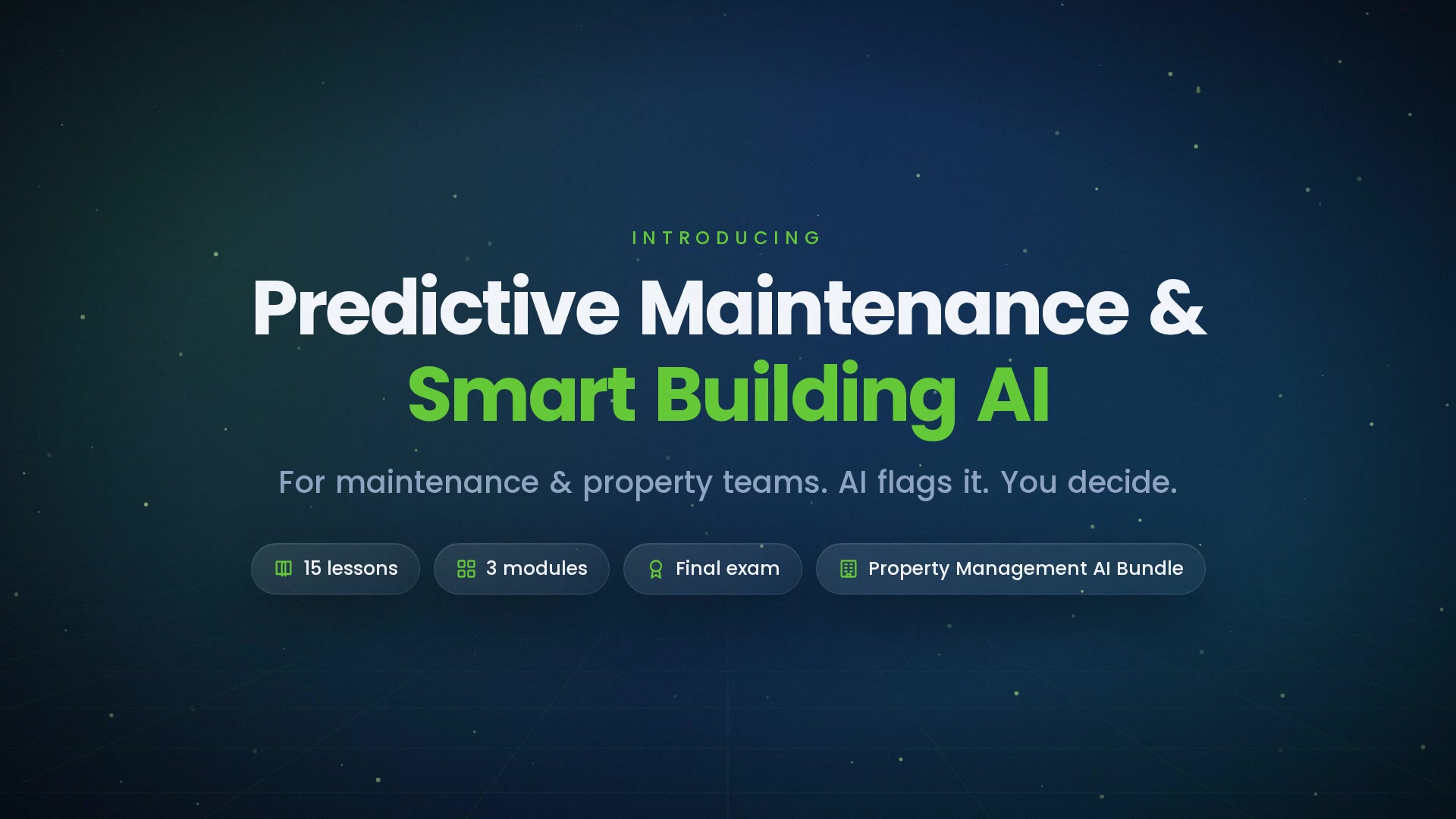
Predictive Maintenance & Smart Building AI

Predictive maintenance and smart building systems can flag failing equipment before residents notice, but only when the site team knows how to read, check, and act on what the AI says. This course shows maintenance and property teams how to use AI for work-order triage, portfolio prioritization, vendor dispatch, and building alerts while people keep every consequential call. You'll learn where the model proposes and where a person confirms, which safety-critical systems AI only watches, and how to keep building data clean and private. You'll finish with a one-page maintenance AI plan for your own sites.
Certificate included
Video preview
Course details
Duration 1h 23m 29s
Lectures 15
Video 1.5 hours
Quizzes 1
Level Beginner

Course Description

AI can anticipate equipment failure, sort the work-order queue, and track every vendor promise across a portfolio. It can't confirm a fault, clear a safety system, or know the building the way the site team does. This course teaches maintenance teams to use the tools well while staying in charge at every step.

What you'll learn

  • Reactive, preventive, and predictive maintenance, and the flag-check-work-order-close loop
  • AI-assisted intake, triage, and scheduling, with the safety overrides no model decides
  • Vendor dispatch and the vendor record that makes contractors accountable
  • The asset register, sensor data, and work history every prediction depends on
  • Reading and acting on building alerts, honest energy savings, and safety-critical limits
  • Resident data privacy, site pilots, outcome measures, and the questions to ask vendors

Who it's for

Maintenance supervisors, technicians, service coordinators, and property and regional managers who use or are evaluating AI maintenance and smart building platforms.

15 short video lessons in three modules: Maintenance With AI; Smart Building Systems; and Making It Work on Site.

This course is training, not engineering, safety, or legal advice. Qualified professionals, company policy, and local codes govern.

Module 1: Maintenance With AI
Module 2: Smart Building Systems
Module 3: Making It Work on Site

Learn at your own pace

Study the materials at your convenience, you can always return to them to repeat

RiseCert illustration: Course structure: 3 modules of 5 lessons, 15 of 15 lit

Certificate of completion

Complete every lesson and pass the final exam to earn a RiseCert certificate of completion you can download and share.

RiseCert certificate of completion background

Your Name

Predictive Maintenance & Smart Building AI

RISECERT

CERTIFICATE

For demonstrated knowledge and successful completion of all course requirements for:

MM.DD.YYYY

Certificate Date

Ready to get started?

Enroll in Predictive Maintenance & Smart Building AI and earn your RiseCert certificate of completion.

Certificate included

Got Questions? We've Got Answers!

Answers to the most common questions about this course.

What is the Predictive Maintenance & Smart Building AI course?
Predictive Maintenance & Smart Building AI is a RiseCert online course that teaches property management teams to use AI to anticipate equipment failure, triage and prioritize work orders, and manage vendor dispatch across a portfolio, with the site team in charge at every step. It includes 15 video lessons (just under 1.5 hours) and a final exam.
Who should take a predictive maintenance AI course for property management?
Maintenance supervisors, technicians, service coordinators, and property and regional managers who use or are evaluating AI work-order, smart building, or predictive maintenance platforms. It also suits facilities and asset managers who oversee maintenance across several sites and need a practical way to decide what the tools may set and what a person must confirm.
What is predictive maintenance in property management?
Predictive maintenance means servicing equipment when the data says wear is coming, rather than after it fails (reactive) or on a fixed calendar (preventive). Readings, run hours, and work history flag a unit before it breaks. The course teaches the condition-based version most sites can run today, and notes that most portfolios run all three modes at once.
What data does predictive maintenance need to work?
Three core sources: an asset register that matches what is physically on site, sensor readings over time, and a work history that records what failed, what was found, and what was done. All three must share one asset ID. The course shows that real work-order closes are the biggest accuracy lever, and that models learn over months, not weeks.
Can AI decide which maintenance requests are emergencies?
No. In the course, AI may propose a category, urgency, and routing, but a person confirms anything rated emergency. Safety words such as gas, smoke, carbon monoxide, active water intrusion, no heat or water, electrical hazards, and life-safety faults force emergency handling and a human call, whatever the model proposed. Your procedures and local codes set the exact list.
Can a smart building platform clear a fire alarm or elevator fault?
No. For safety-critical systems, including fire and life safety, elevators, gas, electrical distribution, boilers, and structural elements, the course teaches that AI may monitor, flag, draft, track, and spot patterns. Only a qualified person declares a system safe, returns it to service, certifies a test, or bypasses a safety device. Local codes define who is qualified.
Does the course cover resident privacy and building data security?
Yes. A dedicated lesson explains why door and fob logs, unit-level water and energy patterns, cameras, in-unit sensors, and work-order text are personal data about residents. It covers purpose limits, minimum data, role-based access, retention, no profiling, and vendor access through named, least-privilege, time-boxed accounts that are removed the day a contract ends.
Do I need an engineering or technical background?
No. The course is written for property management and maintenance teams in plain language, with no coding or data science. Experience with work orders and site operations helps. It does not teach equipment repair or replace trade training or licensing; it teaches how to work with AI output so the right people make the right calls.
What will I be able to do after completing the course?
You'll be able to triage AI-proposed work orders with the safety overrides, review priority scores and schedules, dispatch vendors and keep an accountable vendor record, verify and document building alerts, review energy recommendations, protect resident data, pilot a platform at one site, measure real outcomes, question vendor claims, and write a one-page maintenance AI plan.
Which maintenance platforms or tools does the course cover?
The course is vendor-neutral. It covers the kinds of tools property teams use: predictive maintenance platforms, AI work-order intake and scheduling, vendor dispatch tools, connected building sensors and controls, and energy analytics. No specific product is required or endorsed, and a full lesson covers the questions and contract terms for evaluating any vendor.
How is this different from a building automation or facilities course?
Building automation and trade courses teach how equipment and controls work. This course focuses on the decisions around AI output: where the model proposes and a person confirms, how to read an alert before acting, keeping the data honest, protecting resident privacy, and measuring outcomes rather than platform activity. It complements technical training rather than replacing it.
Is the course content up to date?
Yes. The course reflects smart building and predictive maintenance practice as of September 2026, including common vendor claims and tightening privacy expectations for connected buildings. Because platforms change quickly, it emphasizes durable habits: check before you act, record what you found, and keep people in charge of safety-critical and resident-facing decisions.
How long does the course take to complete?
The course has just under 1.5 hours of video across 15 lessons, plus a final exam. Lessons run about five to six minutes and are organized into three modules: Maintenance With AI; Smart Building Systems; and Making It Work on Site. Most learners finish in a few sittings.
Is the course online and self-paced?
Yes. The course is 100% online and self-paced, and your access does not expire. You can start, pause, and resume at any time on a computer, tablet, or phone with a modern web browser. There's nothing to install.
Is there a final exam?
Yes. The course ends with a 30-question multiple-choice final exam covering all three modules. You need a score of 80% or higher (24 of 30) to pass, and you can retake the exam as many times as you need. Finish all 15 lessons and pass the exam to complete the course.
Do I get a certificate of completion?
Yes. After you complete all 15 lessons and pass the final exam, you can download a RiseCert certificate of completion. It is a course completion certificate, not a license, a trade or professional certification, or a continuing education (CE) certificate.
Does the course count for real estate or property management CE credit?
No. The course is not currently approved for real estate or property management continuing education (CE) credit in any state, and it is not accredited for CE, CEU, or CPE credit by any licensing body. For license-renewal hours, take a course approved by your state commission or regulator.
Is this course engineering, safety, or legal advice?
No. The course is educational and is not engineering, safety, or legal advice. Qualified professionals, your company's policies, local codes, and local landlord-tenant law govern how equipment is serviced, how safety systems are handled, and how habitability and unit-entry rules apply. Consult the appropriate professional or counsel for a specific situation.
How much does the course cost, and can I enroll my team?
The course costs $99 per learner as a one-time purchase, with no subscription or recurring fees. To enroll a maintenance team or a whole portfolio's site staff, contact RiseCert through the Contact Us page at risecert.org.
What is the refund policy?
All sales are final and no refunds are issued, as stated in the RiseCert Terms of Use. Please review the course description, lesson list, and these FAQs before purchasing, and contact RiseCert with any questions first.
