
RiseCert

RiseScore
How AI-fluent are you, really? Free · Get your RiseScore and a shareable badge How it works
Begin Assessment

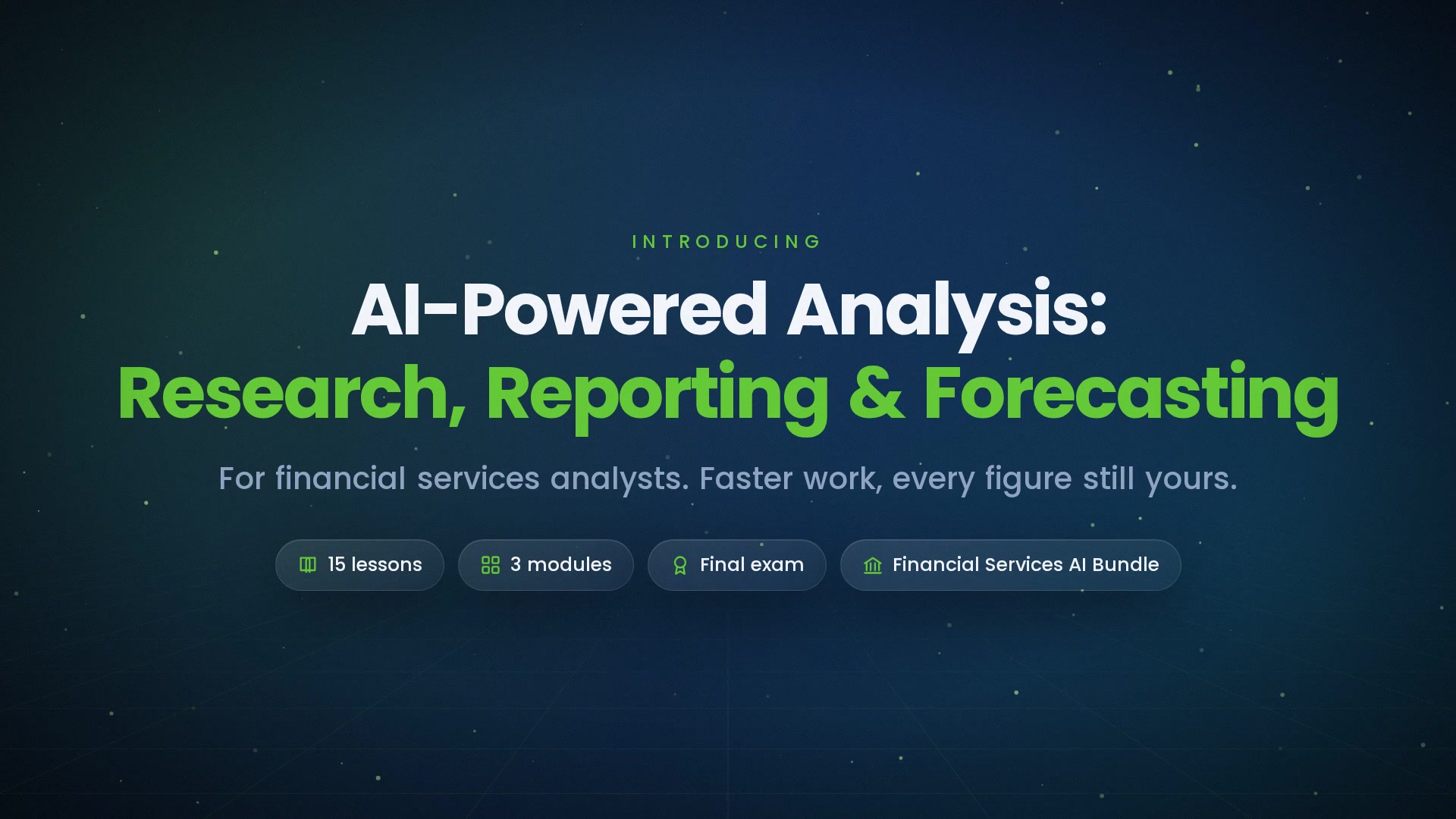
AI-Powered Analysis: Research, Reporting & Forecasting

AI assistants read filings, draft memos, and structure forecasts faster than any analyst, but they don't know when they're wrong. This course teaches financial services analysts to use AI for research, credit memos, models, board reporting, and forecasting while keeping accuracy, auditability, and independence intact. You'll learn to recompute every figure, label period, entity, and basis, keep a record an auditor can retrace, and present AI-assisted work with honest confidence. You'll finish with a one-page analysis standard and a pre-delivery checklist for every deliverable.
Certificate included
Video preview
Course details
Duration 1h 12m 17s
Lectures 15
Video 1.25 hours
Quizzes 1
Level Beginner

Course Description

Financial analysis is reading, extracting, calculating, and writing. An AI assistant does the reading and first drafting at remarkable speed, but in financial work a confident wrong number is worse than no number. This course shows analysts how to put AI to work while the numbers, the judgment, and the signature stay theirs.

What you'll learn

  • What AI does well and badly with financial material, and the verification stance that follows
  • Research from controlled sources, recency checks, and credit memos with recomputed figures
  • AI in spreadsheets and models, and reading AI analysis critically for plausible-but-wrong errors
  • Board narratives from locked numbers, forecasting support, and the bright line in regulatory reporting
  • Auditability, independence from the tool's framing, and data rules for client data and MNPI
  • Defensible review and sign-off, honest confidence, and a one-page analysis standard

Who it's for

Credit, research, planning, and reporting analysts in banking and financial services, and the reviewers and managers who sign off on their work.

15 short video lessons in three modules: Research and Memos; Reporting and Forecasting; and Standards and Judgment.

This course is educational and is not investment, legal, or financial advice. Your institution's policies govern.

Module 1: Research and Memos
Module 2: Reporting and Forecasting
Module 3: Standards and Judgment

Learn at your own pace

Study the materials at your convenience, you can always return to them to repeat

RiseCert illustration: Course structure: 3 modules of 5 lessons, 15 of 15 lit

Certificate of completion

Complete every lesson and pass the final exam to earn a RiseCert certificate of completion you can download and share.

RiseCert certificate of completion background

Your Name

AI-Powered Analysis: Research, Reporting & Forecasting

RISECERT

CERTIFICATE

For demonstrated knowledge and successful completion of all course requirements for:

MM.DD.YYYY

Certificate Date

Ready to get started?

Enroll in AI-Powered Analysis: Research, Reporting & Forecasting and earn your RiseCert certificate of completion.

Certificate included

Got Questions? We've Got Answers!

Answers to the most common questions about this course.

What is the AI-Powered Analysis: Research, Reporting & Forecasting course?
AI-Powered Analysis: Research, Reporting & Forecasting is a RiseCert online course for financial services analysts. It teaches how to use AI assistants for research, credit memos, models, management and board reporting, and forecasting while keeping accuracy, auditability, and independence intact. It includes 15 video lessons (about 1 hour 15 minutes) and a final exam.
Who should take an AI course for financial analysts?
The course is built for credit, research, planning, and reporting analysts at banks and financial institutions, plus the reviewers and managers who sign off on their work. It suits anyone who drafts credit memos, research notes, board packs, forecasts, or regulatory narratives and wants to use AI assistants without compromising the numbers or the judgment.
Can AI be trusted to calculate financial ratios?
Not without checking. AI-Powered Analysis teaches that arithmetic and ratios from raw figures are among the things an AI assistant does worst. Leverage, coverage, liquidity, margins, growth rates, and covenant headroom are rebuilt by the analyst from verified source figures, and when the tool's number differs from the analyst's, the analyst's number stands.
What are the most common errors in AI-generated financial analysis?
The course names six recurring patterns: stale figures, mixed periods and bases, invented ratios, the wrong entity (such as group figures used for a subsidiary), unsupported adjectives like "robust" on small changes, and dropped caveats such as a restatement or going-concern note. Lesson 1.5 teaches a critical-reading routine to catch each one.
How can I use AI to write a credit memo?
In this course, AI drafts the narrative sections of a credit memo, such as the business description, industry context, and financial commentary, from verified inputs with citations. The analyst recomputes every decision-carrying figure and writes the risk assessment and recommendation personally under credit policy. The assistant may list considerations, but it never concludes, recommends, or assigns a grade.
Can AI be used for regulatory reporting and financial filings?
Within limits. The course draws a bright line: AI may help draft narrative from approved figures and text, run consistency and cross-reference checks, and format. It may not produce or adjust reported figures, draft attestations or certifications, decide materiality, or serve as the last reviewer. These statements reflect the course content as of September 2026.
What is the analysis standard taught in the course?
The final lesson sets out a one-page standard: what the tool may do, what the analyst verifies, what the record holds, how confidence is stated, and what the analyst signs. A six-line pre-delivery checklist runs on every deliverable. The summary rule is: source, recompute, label everything, read for what's missing, argue the other side, state the range, own the conclusion.
Do I need technical or AI experience to take this course?
No coding or AI expertise is required. The course assumes working familiarity with financial analysis, such as financial statements, credit memos, models, and reporting, and explains the AI side in plain language with banking and financial services examples. If you already use an AI assistant at work, it will sharpen how you verify and document that use.
How is this course different from a general AI productivity course?
General courses focus on getting more out of AI tools. This course focuses on the controls financial analysis requires: recomputing numbers, labeling period, entity, and basis, auditable records, independence from the tool's framing, data rules for client data and material nonpublic information, defensible review and sign-off, and honest statements of confidence.
Which AI tools does the course cover?
The course is vendor-neutral and teaches practices that apply to any AI assistant your institution has approved. It stresses using approved tools within their approved data scope, checking the approved-tool list by data class, and keeping the tool and version in the record. No specific product is required, recommended, or endorsed.
Is the course content current?
Yes. AI-Powered Analysis dates its statements as of September 2026, including its notes that supervisory expectations on AI in reporting are still being articulated. Because rules and tools keep changing, the course emphasizes durable practices, such as controlled sources, recomputation, versioned records, and human sign-off, and your institution's current policies always govern.
How long does the course take?
The course has about 1 hour 15 minutes of video across 15 lessons, plus a final exam. Lessons run about five minutes each and are organized into three modules: Research and Memos; Reporting and Forecasting; and Standards and Judgment. Most learners can finish in a few sittings.
Is the course online and self-paced?
Yes. The RiseCert course is 100% online and self-paced, and your access does not expire. You can start, pause, and resume at any time on a computer, tablet, or phone with a modern web browser. There is nothing to install.
Is there a final exam?
Yes. The course ends with a 30-question multiple-choice final exam covering all three modules. You need a score of 80% or higher (24 of 30) to pass, and you can retake the exam as many times as you need. Complete all 15 lessons and pass the exam to finish the course.
Will I receive a certificate?
Yes. After you complete all 15 lessons and pass the final exam, you can download a RiseCert certificate of completion. It is a course completion certificate, not a license, a professional certification, or a continuing education certificate, and it does not replace any credential your role requires.
Can I earn CPE or continuing education credit for this course?
No. The course is not currently approved or accredited for continuing education credit, including CPE, CE, or CEU credit, by any state board, licensing body, or professional organization. If you need credit hours for a license or designation, take a course approved by the body that governs it.
Is this course investment, legal, or financial advice?
No. AI-Powered Analysis is educational training. It is not investment, legal, accounting, regulatory, or financial advice. Your institution's policies, information-barrier and data rules, and professional standards govern how you use AI at work. For a specific situation, follow your institution's guidance and consult compliance or qualified counsel.
How much does the course cost, and can I enroll my team?
The course costs $99 per learner as a one-time purchase, with no subscription or recurring fees. To enroll an analyst team, department, or institution, contact RiseCert through the Contact Us page at risecert.org to discuss team access.
What is the refund policy?
All sales are final and no refunds are issued, as stated in the RiseCert Terms of Use. Please review the course description, lesson list, and these FAQs before purchasing, and contact RiseCert with any questions before you enroll.
Does the course cover material nonpublic information and client data?
Yes. Lesson 3.1 covers data rules for analysts: which data categories may go into which tools, why material nonpublic information is the strictest tier and often goes into no AI tool at all, why outputs inherit the source's classification, and why misuse should be reported the same day. Your institution's policies govern.
