
RiseCert

RiseScore
How AI-fluent are you, really? Free · Get your RiseScore and a shareable badge How it works
Begin Assessment

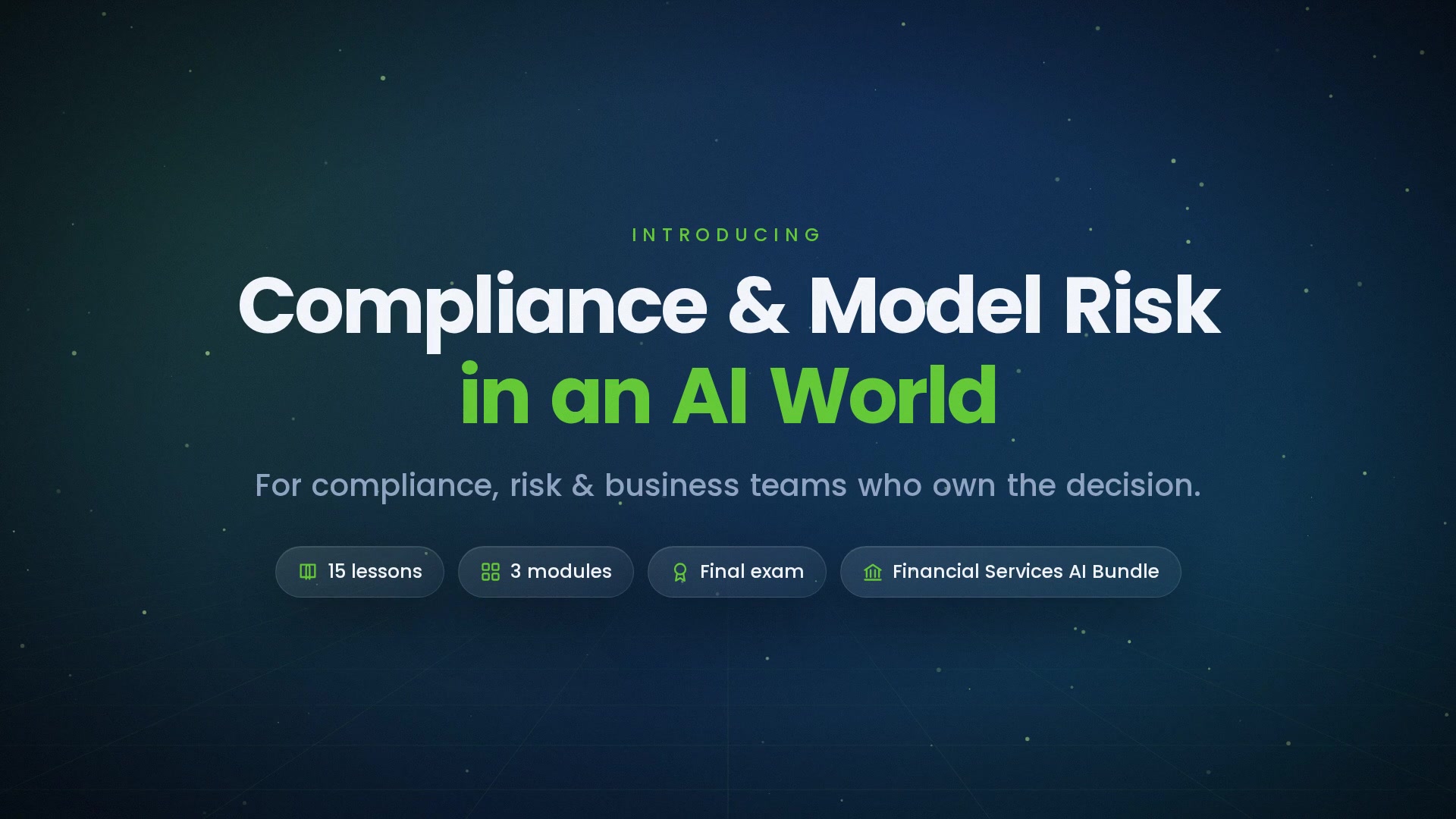
Compliance & Model Risk in an AI World

AI stretched the definition of a model, and financial institutions now run vendor engines, generative tools, and chatbots that influence customers and decisions. This course applies model risk management to AI at principle level, with regulatory statements dated as of September 2026. You'll learn to inventory and tier AI uses, validate models you didn't build, test fairness and adverse-action reasons, and keep documentation that survives an exam. You'll finish with a one-page inventory line and a ten-question checklist for every model review.
Certificate included
Video preview
Course details
Duration 1h 13m 04s
Lectures 15
Video 1.25 hours
Quizzes 1
Level Beginner

Course Description

Model risk management has been part of financial-services supervision for over a decade, built around scorecards, pricing, and capital models. AI stretched it: vendor engines, language models, prompts, and chatbots now shape customer outcomes. This course shows how to inventory, validate, monitor, and govern them at principle level.

What you'll learn

  • What counts as a model now, and which AI uses belong in the inventory
  • The model lifecycle under AI, and validation against your own evaluation set
  • Explanations that reflect real model behavior, and vendor models managed as your own
  • Fair-lending testing, the less discriminatory alternative search, and adverse-action reasons
  • Chatbot controls, data governance, and the model file, decision record, and change log
  • Three-lines roles, risk tiering, drift monitoring, and model incident remediation

Who it's for

Model owners, model risk and validation teams, compliance and fair-lending staff, internal auditors, and business leaders at financial institutions who own, challenge, or audit AI uses.

15 short video lessons in three modules: Model Risk Fundamentals; Fairness, Consumers, and Decisions; and Operating the Framework.

This course is educational and is not legal, compliance, or regulatory advice. Your model risk policy and counsel govern.

Module 1: Model Risk Fundamentals
Module 2: Fairness, Consumers, and Decisions
Module 3: Operating the Framework

Learn at your own pace

Study the materials at your convenience, you can always return to them to repeat

RiseCert illustration: Course structure: 3 modules of 5 lessons, 15 of 15 lit

Certificate of completion

Complete every lesson and pass the final exam to earn a RiseCert certificate of completion you can download and share.

RiseCert certificate of completion background

Your Name

Compliance & Model Risk in an AI World

RISECERT

CERTIFICATE

For demonstrated knowledge and successful completion of all course requirements for:

MM.DD.YYYY

Certificate Date

Ready to get started?

Enroll in Compliance & Model Risk in an AI World and earn your RiseCert certificate of completion.

Certificate included

Got Questions? We've Got Answers!

Answers to the most common questions about this course.

What is the Compliance & Model Risk in an AI World course?
Compliance & Model Risk in an AI World is a RiseCert online course that applies model risk management to AI in financial services. It covers what counts as a model, validation, explainability, vendor models, fair lending, adverse-action reasons, chatbots, data governance, documentation, three-lines roles, tiering, monitoring, and incidents. It includes 15 video lessons (about 76 minutes) and a final exam.
Who should take an AI model risk management course?
Model owners, model risk and validation staff, compliance and fair-lending professionals, internal auditors, risk managers, and business leaders at banks and other financial institutions who own, challenge, or audit AI uses. It also suits product and operations teams deploying vendor AI, chatbots, or document tools that influence customers or decisions.
What is model risk management?
Model risk management is the discipline of controlling the risk that a model is wrong or misused. It follows a lifecycle of development, validation, implementation, use, monitoring, and change and retirement, with controls at each stage. The course notes it has been part of financial-services supervision for over a decade and shows where AI stresses each stage.
Is a generative AI tool or chatbot considered a model?
Usually, yes. The course's working test asks whether a tool's output influences a customer, a decision, a risk measure, or a report. AI drafting customer letters at scale, chatbots answering customers, and extraction feeding underwriting belong in the inventory, and prompts and configurations count as part of the model. Personal drafting tools are logged as approved tools instead.
How do you validate a vendor AI model you didn't build?
Compliance & Model Risk in an AI World teaches validating it against your own evaluation set and population, treating vendor material as input rather than proof. Undisclosed training data is documented as a limitation with compensating outcome tests, validation holds for a specific version, and contracts need change notice, version holds, explanation access, and exit rights.
What is a less discriminatory alternative search?
It's the documented effort to find whether a model could meet the same business need with less disparate impact, for example by removing proxy features, adjusting weights, or changing thresholds. The course teaches building and testing alternatives, quantifying the trade-off, and recording the decision. As of September 2026, it describes the expectation to search and document as established at principle level.
What is model drift, and how is it monitored?
Drift is when a model stops behaving as it did when validated. The course covers four kinds: input drift, output drift, performance decay, and fairness drift, which can widen even while overall accuracy holds. Monitoring uses metrics with thresholds and owners, distribution tracking, and evaluation-set re-runs, with unexplained shifts treated as unannounced changes.
What will I be able to do after completing the course?
You'll be able to decide which AI uses belong in the model inventory, tier them by consequence, design outcomes testing for text and scores, validate explanations, secure vendor contract rights, run disparate impact testing, build an accurate adverse-action reason process, keep exam-ready documentation, set re-validation triggers, run a model incident, and use a ten-question model risk checklist.
Do I need a data science or statistics background?
No. The course works at principle level in plain language, so you don't need to be a data scientist or statistician, and there are no formal prerequisites. Some familiarity with banking compliance, credit decisions, or risk management helps, because the course builds on those ideas and applies them to vendor engines, chatbots, and generative models.
Does the course cover fair lending and adverse-action reasons?
Yes. Module 2 covers fair-lending exposures from AI, including proxies, historical bias, feature interactions, and differential accuracy; disparate impact testing at a working level; the less discriminatory alternative search; and adverse-action reasons that are specific, accurate, actionable, and demonstrable, produced from validated attributions and tested monthly as a model output.
How is this different from a general AI compliance course?
General AI compliance courses survey laws and frameworks across industries. Compliance & Model Risk in an AI World applies the financial-services model risk discipline to AI specifically: model inventories, validation, vendor contracts, fair lending, adverse-action reasons, three-lines roles, tiering, drift monitoring, and incident remediation, plus the model file, decision record, and change log examiners read.
Is the course content up to date?
Yes. The course dates its regulatory statements as of September 2026 and works at principle level, so it stays useful as specific rules change. It deliberately leaves jurisdiction-specific requirements, statistical thresholds, and reporting timelines to your institution's compliance team, model risk policy, and regulators' guidance, which always govern.
How long does the Compliance & Model Risk in an AI World course take?
The course has about 76 minutes of video across 15 lessons, plus a final exam. Lessons run about five minutes each and are organized into three modules: Model Risk Fundamentals; Fairness, Consumers, and Decisions; and Operating the Framework. Most learners can finish it in one or two sittings.
Is the course online and self-paced?
Yes. The course is 100% online and self-paced, and your access does not expire. You can start, pause, and resume at any time on a computer, tablet, or phone with a modern web browser. There's nothing to install.
Is there a final exam?
Yes. The course ends with a 30-question multiple-choice final exam covering all three modules. You need a score of 80% or higher (24 of 30) to pass, and you can retake the exam as many times as you need. Finish all 15 lessons and pass the exam to complete the course and earn your certificate.
Do I get a certificate of completion?
Yes. After you complete all 15 lessons and pass the final exam, you can download a RiseCert certificate of completion from your account. It is a course completion certificate, not a license, professional certification, or continuing education (CE or CPE) certificate.
Is the course approved for CE or CPE credit?
No. Compliance & Model Risk in an AI World is not currently approved for continuing education credit, including CE, CPE, or CEU credit, by any state, licensing body, or accrediting organization. If you need credit toward a license or professional designation, take a course approved by the body that issues it.
Is this course legal, compliance, or regulatory advice?
No. The course is educational and is not legal, compliance, regulatory, or financial advice, and it is not endorsed by any regulator. It teaches model risk principles, but your institution's model risk policy, its compliance team and counsel, and your regulators' guidance govern decisions about specific models, disclosures, and reporting.
How much does the course cost, and can I enroll my team?
The course costs $99 per learner as a one-time purchase, with no subscription or recurring fees. To enroll a model risk, compliance, or audit team, contact RiseCert through the Contact Us page at risecert.org.
What is the refund policy?
All sales are final and no refunds are issued, as stated in the RiseCert Terms of Use. Please review the course description, lesson list, and these FAQs before purchasing, and contact RiseCert with any questions first.
