
RiseCert

RiseScore
How AI-fluent are you, really? Free · Get your RiseScore and a shareable badge How it works
Begin Assessment

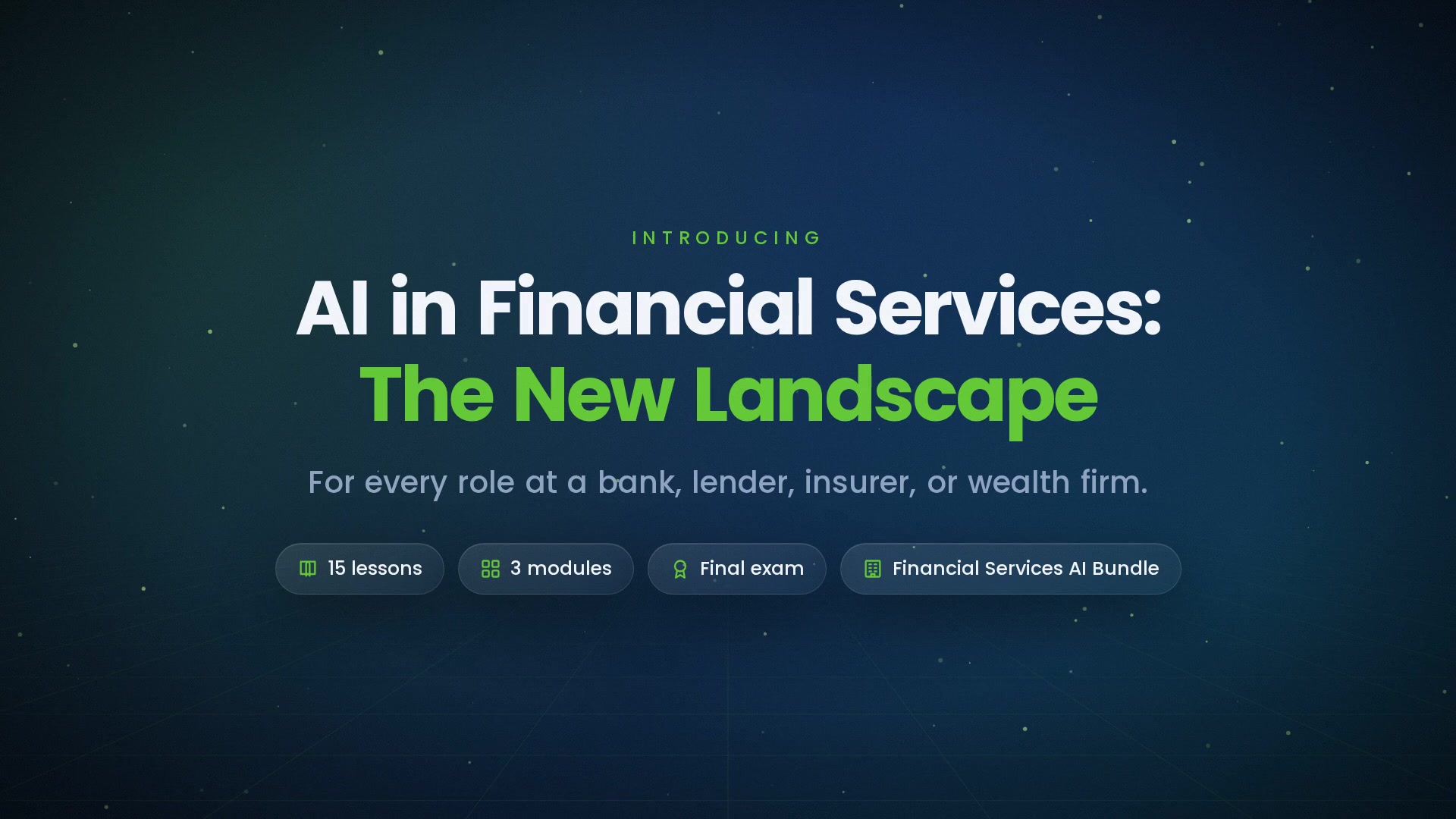
AI in Financial Services: The New Landscape

Banks, lenders, credit unions, insurers, and wealth managers are among the heaviest AI adopters and the most heavily supervised. This course maps where AI is actually landing across four fronts, from lending and advisory to payments, servicing, and the back office. You'll learn the regulatory frame as of September 2026, including fair lending, adverse-action reasons, vendor models, and examination-ready records. You'll finish with the everyday rules for working in an AI-enabled institution and a one-page map of AI in your own role.
Certificate included
Video preview
Course details
Duration 1h 10m 03s
Lectures 15
Video 1.25 hours
Quizzes 1
Level Beginner

Course Description

Most of the value AI delivers in financial services sits on the quiet fronts: documents, drafting, monitoring, and reconciliation. Every use still answers to long-standing supervisory concerns. This course maps where AI is landing, what regulators focus on, and how to work inside the rules, with regulatory points dated as of September 2026.

What you'll learn

  • The four fronts of AI use, and how to separate deployed value from announced ambition
  • AI in lending, advisory, servicing, and operations, and where decision support ends
  • The four regulatory concerns: safety and soundness, fair treatment, consumer protection, and model risk
  • Disparate impact and proxies, and adverse-action reasons that are specific and accurate
  • Vendor model oversight, and records that reconstruct any decision
  • Approved tools, meaningful human review, customer trust, and reading AI output like a banker

Who it's for

Staff, managers, and risk and compliance teams at banks, credit unions, lenders, insurers, and wealth firms who use, review, or oversee AI.

15 short video lessons in three modules: Where AI Is Landing; The Regulatory Frame; and Working in an AI-Enabled Institution.

This course is educational and is not legal, compliance, or financial advice. Your institution's policies and counsel govern.

Module 1: Where AI Is Landing
Module 2: The Regulatory Frame
Module 3: Working in an AI-Enabled Institution

Learn at your own pace

Study the materials at your convenience, you can always return to them to repeat

RiseCert illustration: Course structure: 3 modules of 5 lessons, 15 of 15 lit

Certificate of completion

Complete every lesson and pass the final exam to earn a RiseCert certificate of completion you can download and share.

RiseCert certificate of completion background

Your Name

AI in Financial Services: The New Landscape

RISECERT

CERTIFICATE

For demonstrated knowledge and successful completion of all course requirements for:

MM.DD.YYYY

Certificate Date

Ready to get started?

Enroll in AI in Financial Services: The New Landscape and earn your RiseCert certificate of completion.

Certificate included

Got Questions? We've Got Answers!

Answers to the most common questions about this course.

What is the AI in Financial Services: The New Landscape course?
AI in Financial Services: The New Landscape is a RiseCert online course that maps where AI is landing in banks, lenders, credit unions, insurers, and wealth firms, what regulators focus on, and how employees work safely in an AI-enabled institution. It includes 15 video lessons (about 70 minutes) and a final exam.
Who should take an AI in financial services course?
Anyone who works in or alongside a bank, credit union, lender, insurer, or wealth manager and uses, reviews, or oversees AI: front-line and operations staff, underwriters, servicers, relationship managers, team leads, and risk and compliance staff. The course is built for employees in any role, not for data scientists, and explains what changes for you.
How is AI actually being used in banking and financial services?
The course maps AI onto four fronts: customer interaction, decisioning, operations, and risk and compliance. As of September 2026, widely deployed uses include document intake and extraction, drafting assistance, contact-center summaries, fraud and transaction monitoring, and reconciliation. Fully automated credit without human review, AI advice, and autonomous money movement remain mostly announced or early.
What is the difference between AI decision support and automated decisioning in lending?
In decision support, AI summarizes, calculates, and flags, and a person decides, can override, and has overrides recorded. In automated decisioning, the model's output is the outcome. The course's honest test: if reviewers never change the outcome, the use is automated in practice and needs full model governance, fairness testing, explainable reasons, and monitoring.
Can an AI credit model discriminate if it doesn't use protected characteristics?
Yes. A model can produce disparate impact through proxies: neutral-looking features such as location, device type, or shopping patterns that correlate with protected characteristics, alone or in combination. The course teaches that excluding inputs is necessary but not sufficient, and that institutions test outcomes by group before launch, in production, and after any model change.
What do financial regulators care about when it comes to AI?
The course explains that regulators apply existing concerns to AI: safety and soundness, fair treatment, consumer protection, and model risk, plus data privacy, financial crime, and resilience. At principle level as of September 2026, supervisors ask about inventories, fairness testing, explanations, failure handling, validation, and human review. The answers that hold are documented.
Does the course cover AI vendors and third-party models?
Yes. A full lesson explains why outsourcing a model does not outsource responsibility. It covers due diligence for AI vendors, treating a vendor's validation as input to your own, re-testing after vendor model changes, concentration risk, and the contract terms that matter for data, change notice, performance, audit access, and exit.
Do I need a technical or data science background?
No. The course is written for financial-services employees, not technologists, and explains models, proxies, explainability, and validation in plain language with banking examples. You won't build or code anything. It helps to know your own institution's products and processes, because the final lesson has you map AI onto your own role.
What will I be able to do after completing the course?
You'll be able to place any AI use on its front and judge how consequential it is, tell decision support from automated decisioning, map uses to regulatory concerns and controls, recognize weak adverse-action reasons, apply the approved-tool and data rules, spot rubber-stamp review, check AI output for financial failure patterns, and write a one-page AI map of your role.
Is the course specific to one country or regulator?
No. The course teaches at principle level rather than walking through one regulator's rulebook, so it applies across banking, lending, insurance, and wealth settings. Regulatory statements are dated as of September 2026. Where specifics differ, your institution's policies and your regulators' rules govern, and the course says so throughout.
Is the course content up to date?
Yes. Regulatory and market statements in the course are dated as of September 2026, including which AI uses are widely deployed and what supervisors are asking at principle level. Because rules and tools keep changing, the course anchors on durable habits: know the front, know the consequence, verify, escalate, and report.
How long does AI in Financial Services: The New Landscape take?
The course has about 70 minutes of video across 15 lessons, plus a final exam. Lessons run about four to five minutes each and are organized into three modules: Where AI Is Landing; The Regulatory Frame; and Working in an AI-Enabled Institution. Most learners finish in one or two sittings.
Is the course online and self-paced?
Yes. The course is 100% online and self-paced, and your access does not expire. You can start, pause, and resume at any time on a computer, tablet, or phone with a modern web browser. There's nothing to install.
Is there a final exam?
Yes. The course ends with a 30-question multiple-choice final exam covering all three modules. You need a score of 80% or higher (24 of 30) to pass, and you can retake the exam as many times as you need. Finish all 15 lessons and pass the exam to complete the course and earn your certificate.
Do I get a certificate of completion?
Yes. After you complete all 15 lessons and pass the final exam, you can download a RiseCert certificate of completion from your account. It is a course completion certificate, not a license, professional certification, or continuing education (CE) certificate.
Does the course count for CE, CPE, or FINRA continuing education credit?
No. The course is not currently approved for continuing education credit of any kind, including CE, CPE, FINRA, or insurance CE, by any state, regulator, or licensing body. For required training or license-renewal hours, take a course approved by the relevant body. This course complements that training with practical AI knowledge.
Is the course endorsed by a financial regulator?
No. AI in Financial Services: The New Landscape is an independent RiseCert training course. It is not endorsed, approved, or reviewed by any regulator or supervisory agency. It summarizes supervisory concerns at principle level as of September 2026, and completing it does not demonstrate regulatory compliance for you or your institution.
Is this course legal, compliance, or financial advice?
No. The course is educational and is not legal, compliance, regulatory, investment, or financial advice. It teaches principles and everyday practices for using AI in financial services, but it can't tell you what your institution must do. Your institution's policies, your regulators' rules, and qualified counsel govern specific decisions.
How much does the course cost, and can I enroll my team?
The course costs $99 per learner as a one-time purchase, with no subscription or recurring fees. To enroll a team, branch, or department, contact RiseCert through the Contact Us page at risecert.org.
What is the refund policy?
All sales are final and no refunds are issued, as stated in the RiseCert Terms of Use. Please review the course description, lesson list, and these FAQs before purchasing, and contact RiseCert with any questions first.
