
RiseCert

RiseScore
How AI-fluent are you, really? Free · Get your RiseScore and a shareable badge How it works
Begin Assessment

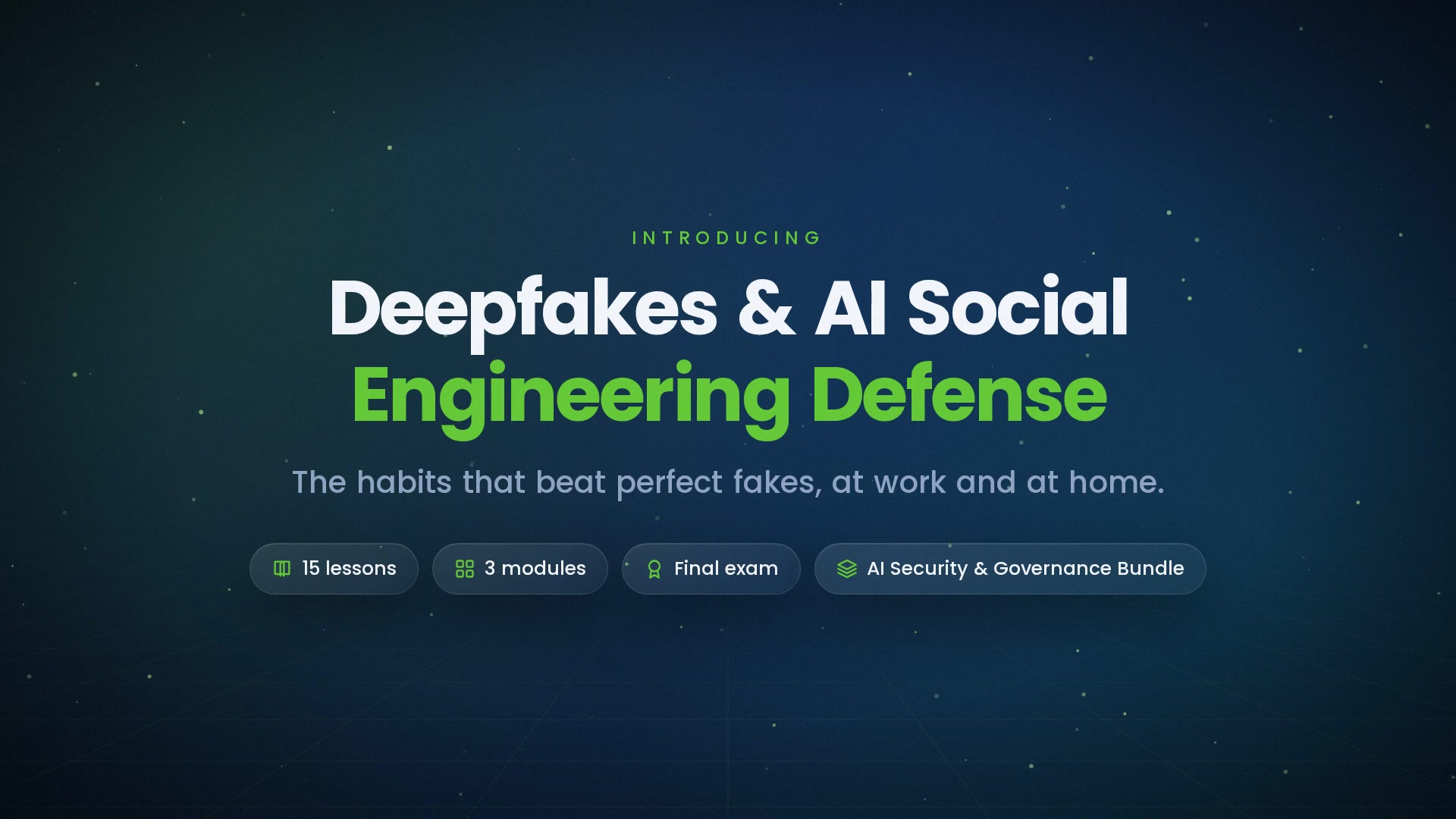
Deepfakes & AI Social Engineering Defense

Cloned voices, deepfaked video calls, and flawless phishing now target people rather than machines, and nobody can reliably spot a good fake. This hands-on course teaches the one skeleton every con shares and the verification protocols that beat it in any costume. You'll learn out-of-band verification, code words, callback culture, dual approval, and the STOP drill for pressure moments. You'll finish knowing what to do when you suspect, what to do in the first hour if you slipped, and how to protect your team and family.
Certificate included
Video preview
Course details
Duration 1h 03m 10s
Lectures 15
Video 1 hour
Quizzes 1
Level Beginner

Course Description

Every social engineering attack, however advanced the AI behind it, is identity plus pretext plus pressure plus ask. AI perfected the first three; the ask can't hide. This course trains you to judge the request, verify through a channel you choose, and report fast, so the fake's quality never decides the outcome.

What you'll learn

  • The four-part skeleton of every con, and the levers of authority, urgency, fear, and helpfulness
  • Spotting AI phishing by sender, links, and context, and handling voice-clone calls and deepfake meetings
  • Breaking multi-channel attack chains with verification you originate
  • Out-of-band verification, code words, callback culture, and dual approval on payments and data
  • Executive impersonation, BEC 2.0, and the STOP drill for verifying under pressure
  • The suspicion playbook, the fast first hour, and protecting your likeness, team, and family

Who it's for

Employees in any role, especially finance, accounts payable, executive assistants, and executives, plus anyone who wants to protect family members from voice-clone scams.

15 short video lessons in three modules: Know the Con; Verification Protocols; and Response & Culture.

This course is awareness training and is not legal or security-consulting advice. Your employer's security policy governs.

Module 1: Know the Con
Module 2: Verification Protocols
Module 3: Response & Culture

Learn at your own pace

Study the materials at your convenience, you can always return to them to repeat

RiseCert illustration: Course structure: 3 modules of 5 lessons, 15 of 15 lit

Certificate of completion

Complete every lesson and pass the final exam to earn a RiseCert certificate of completion you can download and share.

RiseCert certificate of completion background

Your Name

Deepfakes & AI Social Engineering Defense

RISECERT

CERTIFICATE

For demonstrated knowledge and successful completion of all course requirements for:

MM.DD.YYYY

Certificate Date

Ready to get started?

Enroll in Deepfakes & AI Social Engineering Defense and earn your RiseCert certificate of completion.

Certificate included

Got Questions? We've Got Answers!

Answers to the most common questions about this course.

What is the Deepfakes & AI Social Engineering Defense course?
Deepfakes & AI Social Engineering Defense is a RiseCert online course on beating attacks that target people rather than machines. It covers AI phishing, voice-clone calls, deepfake video meetings, multi-channel attack chains, and executive impersonation, plus the verification protocols, response playbooks, and culture habits that work even when the fake is flawless.
Who should take a deepfake awareness course?
The course suits employees in any role, with extra value for people who can move money or data: accounts payable, finance, executive assistants, and executives. It also covers protecting yourself and your family at home, including elders targeted by grandparent scams and teens targeted by sextortion and fake-friend scams. No technical background is needed.
How can you tell if a voice or video call is a deepfake?
Often you can't, and the course doesn't ask you to. The best fakes show no glitches, and caller ID is spoofable. Deepfakes & AI Social Engineering Defense teaches you to judge behavior and the request instead, then verify out-of-band: a channel different from the request's, chosen by you, and established before the request existed.
What is out-of-band verification?
Out-of-band verification means confirming a request through a channel that is different from the one it arrived on, chosen by you rather than the requester, and established before the request existed, such as a saved contact or the number on your card. The course's test is simple: did I possess this channel before today? If not, it doesn't count.
How does a family code word protect against voice-clone scams?
A family code word is a pre-agreed phrase that real family members can give when something is truly wrong. Clones are built from harvested public data, so a phrase agreed in person and never posted is out of reach. The course pairs it with the callback habit and a rule that no real emergency is hurt by a two-minute check.
What is BEC 2.0?
Business email compromise impersonates executives and partners to redirect payments. The course calls the AI-upgraded version BEC 2.0: a fluent email in the executive's real style, a voice-clone follow-up, video if needed, and multi-channel chains over days. Attention can't catch it; the stacked protocol of out-of-band verification, code words, and dual approval does.
What should I do if I already clicked a phishing link or sent money?
Act fast. After a click or credential slip, report to security first, change the password everywhere it's reused, revoke sessions, and watch for follow-ups, about 15 minutes. After a fraudulent payment, call your bank's fraud line now, report to law enforcement such as IC3 in the US, alert finance, and never pay cold-calling recovery services.
What will I be able to do after this course?
You'll be able to dissect any con into identity, pretext, pressure, and ask; check senders, links, and context; exit a suspicious call politely; verify inside a meeting; break multi-channel chains; run out-of-band checks, code words, and dual approval; use the STOP drill under pressure; run the suspicion and first-hour playbooks; and teach the five-minute kit.
How is this different from general phishing awareness training?
General training often teaches spotting fakes by typos and odd logos. Deepfakes & AI Social Engineering Defense assumes the fake is perfect across email, voice, and video, and builds protocols that ignore fake quality: out-of-band verification, code words, callback culture, dual approval, and a rehearsed STOP drill, plus guidance for executives being impersonated and for protecting family.
Do I need technical knowledge to take this course?
No. There are no prerequisites. The course is hands-on and plain-language, built around scenarios such as a Friday vendor call asking to reroute invoices, a deepfaked meeting with senior faces, and a late-night call in a child's voice. It gives you rehearsable exit lines and habits that need no budget or technical skill.
How long is the course?
The course has about an hour of video, just over 64 minutes, across 15 lessons, plus a final exam. Lessons run about four minutes each and are organized into three modules: Know the Con; Verification Protocols; and Response & Culture. Most learners finish it in one or two sittings.
Is the course self-paced, and how long do I have access?
Yes. The course is 100% online and self-paced, and your access does not expire. You can start, pause, and resume at any time on a computer, tablet, or phone with a modern web browser. There's nothing to install, so you can revisit the protocols before setting up a family code word or team callback norm.
Is there a final exam?
Yes. The course ends with a 30-question multiple-choice final exam covering all three modules. You need a score of 80% or higher, 24 of 30, to pass, and you can retake the exam as many times as you need. Finish all 15 lessons and pass the exam to complete the course and earn your certificate.
Will I get a certificate?
Yes. After you complete all 15 lessons and pass the final exam, you can download a RiseCert certificate of completion from your account. It is a course completion certificate, not a license, professional security certification, or continuing education (CE or CPE) certificate.
Is the course approved for CPE or continuing education credit?
No. Deepfakes & AI Social Engineering Defense is not currently approved for continuing education credit, including CE, CPE, or CEU credit, by any state, licensing body, or accrediting organization. If you need credit toward a license or professional designation, take a course approved by the body that issues it.
Is this course legal or security-consulting advice?
No. The course is defensive, awareness-level education and is not legal or security-consulting advice. Your employer's security policy, its security team, and counsel govern what you do at work, including payment controls and incident reporting. For fraud you've already suffered, the course points to your bank and law enforcement.
Does the course recommend deepfake detection tools?
No. The course is vendor-neutral and endorses no product. It treats visual and audio tells as signals that may inform but never decide, because the best fakes show none of them. Its defenses are process-based, verification through a channel you choose, code words, and dual approval, so they keep working as fakes improve.
How much does the course cost?
The course costs $99 per learner as a one-time purchase, with no subscription or recurring fees. To enroll a finance team, department, or whole organization, contact RiseCert through the Contact Us page at risecert.org.
What is the refund policy?
All sales are final and no refunds are issued, as stated in the RiseCert Terms of Use. Please review the course description, lesson list, and these FAQs before purchasing, and contact RiseCert through the Contact Us page at risecert.org with any questions first.
Will the course help me if I'm the executive being impersonated?
Yes. Deepfakes & AI Social Engineering Defense covers the executive's side: announce that you expect callbacks, never make real requests shaped like the con, keep your assistant and finance lead in the code-word loop, and warn the company quickly if you're cloned. Lesson 3.3 adds steps to reduce free voice samples and respond to impersonation.
