
RiseCert

RiseScore
How AI-fluent are you, really? Free · Get your RiseScore and a shareable badge How it works
Begin Assessment

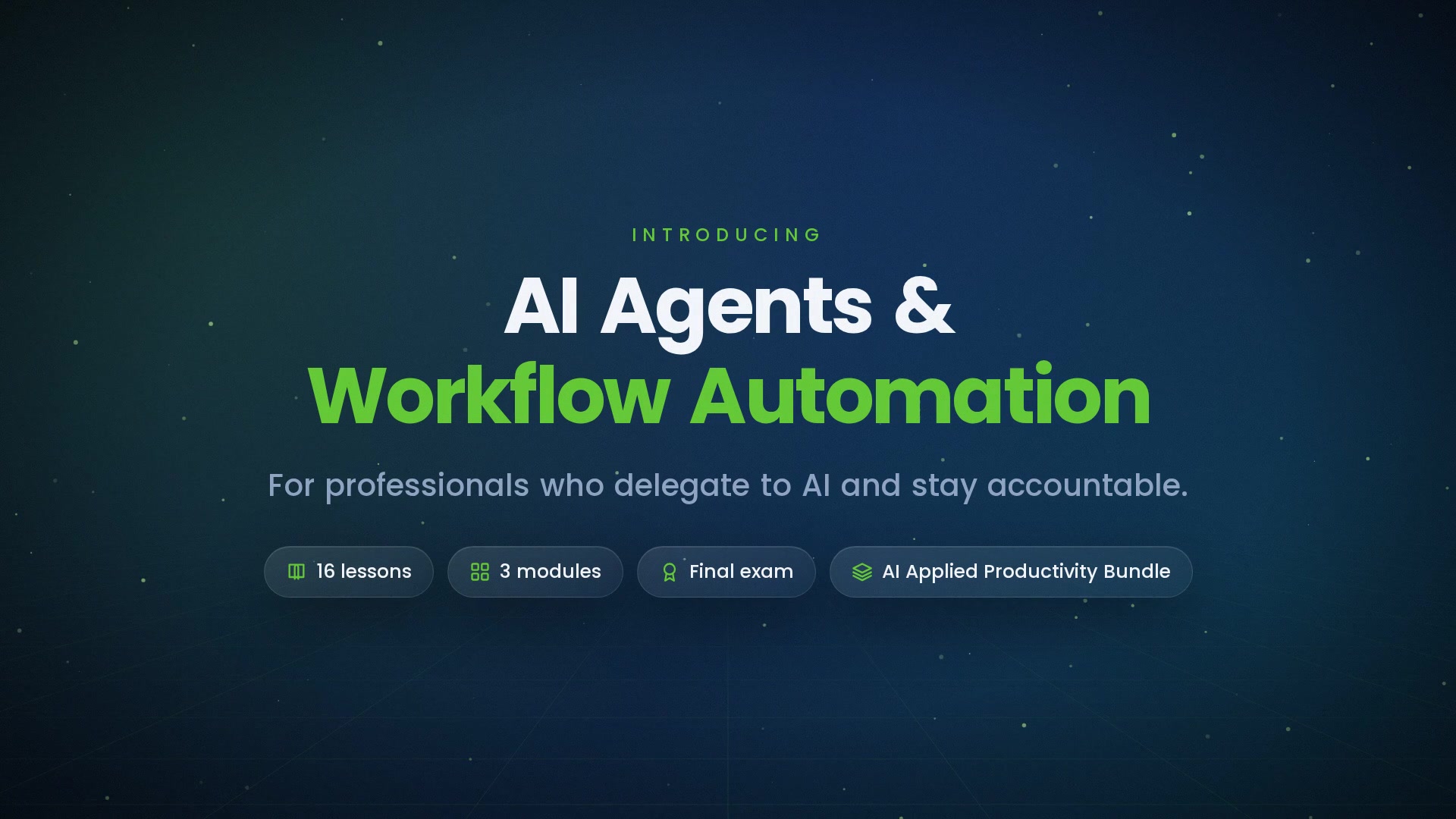
AI Agents & Workflow Automation

Prompting gets answers out of AI; delegation gets work done. This course teaches you to hand multi-step work to AI agents the way a good manager briefs a capable new hire: with a clear goal, the right context, firm constraints, and checkpoints. You'll learn to scope tasks, stage workflows, recover when an agent goes wrong, and decide what should never be automated. Throughout, you'll keep oversight, security, and accountability where they belong: with you.
Certificate included
Video preview
Course details
Duration 56m 25s
Lectures 16
Video 1 hour
Quizzes 1
Level Intermediate

Course Description

AI agents don't just answer questions. They plan, use tools, and take real actions across many steps. That makes delegation the next AI skill, and it raises the stakes on every mistake. This course teaches you to delegate work to agents with the structure, supervision, and judgment a professional needs.

What you'll learn

  • How agents work: the plan–act–observe loop, tools as permissions, and why errors compound
  • The four tiers of workplace automation, and how to match the tier to the task
  • Writing task briefs with a clear definition of done, and handing off context safely
  • Placing checkpoints, staging multi-step workflows, and recovering from agent failures
  • Autonomy levels, least-privilege access, and the red lines that stay human
  • Quality control, audit trails, and staying accountable for automated work

Who it's for

Professionals and managers who already use AI chat tools or copilots and are ready to delegate multi-step work to agents. No coding required.

16 short video lessons in three modules: Understanding AI Agents; Delegating Work to AI; and Oversight, Risk & Responsible Automation.

Module 1: Understanding AI Agents
Module 2: Delegating Work to AI
Module 3: Oversight, Risk & Responsible Automation

Learn at your own pace

Study the materials at your convenience, you can always return to them to repeat

RiseCert illustration: Course structure: 3 modules of 5 lessons, 15 of 15 lit

Certificate of completion

Complete every lesson and pass the final exam to earn a RiseCert certificate of completion you can download and share.

RiseCert certificate of completion background

Your Name

AI Agents & Workflow Automation

RISECERT

CERTIFICATE

For demonstrated knowledge and successful completion of all course requirements for:

MM.DD.YYYY

Certificate Date

Ready to get started?

Enroll in AI Agents & Workflow Automation and earn your RiseCert certificate of completion.

Certificate included

Got Questions? We've Got Answers!

Answers to the most common questions about this course.

What is the AI Agents & Workflow Automation course?
AI Agents & Workflow Automation is a RiseCert online course that teaches professionals how to delegate multi-step work to AI agents safely. It covers how agents work, how to write task briefs and place checkpoints, and how to govern automation with autonomy levels, least-privilege access, and quality control. It includes 16 video lessons (about an hour) and a final exam.
Who should take an AI agents and workflow automation course?
Professionals, team leads, and managers who already use AI chat assistants or copilots and want to hand larger, multi-step tasks to AI agents. It also suits anyone who supervises automated work or is asked to automate a team process and needs a practical way to decide what to delegate, what to keep, and how to oversee it.
What is an AI agent, and how is it different from a chatbot?
An AI agent is an AI system that pursues a goal by taking multiple steps and using tools, such as searching, reading files, or running software, rather than answering a single message. A chatbot gives one response per question and you do the work in between. A copilot assists inside an app while you drive. An agent plans, acts, and reports back.
What does human-in-the-loop mean for AI agents?
Human-in-the-loop means a person is built into an automated workflow at defined points to review, approve, or stop the work. The AI Agents & Workflow Automation course treats it as a design input chosen before work begins, using three autonomy levels: draft-only, act-with-approval, and act-and-report, with risk deciding which level each task gets.
Do I need coding or technical skills to use AI agents?
No. The course is written for working professionals, not developers, and teaches delegation as a management skill: writing briefs, providing context, setting checkpoints, and reviewing results. There is no programming. It helps to have used an AI chat assistant or copilot before, because the course builds on prompting and moves you toward delegating whole tasks.
Are there any prerequisites for the course?
There are no formal prerequisites. The AI Agents & Workflow Automation course starts with the basics of what an agent is and how it works before moving to delegation and oversight. Familiarity with everyday AI tools such as chat assistants or built-in copilots is helpful, but every concept is explained in plain language with workplace examples.

What will I be able to do after completing the course?
You'll be able to decide which tasks are ready to delegate, write a task brief with a clear definition of done, hand off context with minimum-necessary access, place checkpoints, stage multi-step workflows, diagnose failures from an agent's work-log, set autonomy levels by risk, spot-check high-volume output, and explain which decisions must stay human.
Which AI agent tools or platforms does the course teach?
The course is vendor-neutral. It teaches skills that apply to any agent or automation tool: single prompts, reusable workflows, embedded copilots, and autonomous agents. No specific product is required or endorsed, and the course reminds learners to run agents only on the platforms their organization has approved.
How is this different from a prompt writing course?
A prompt writing course teaches you to get a good answer from one request. AI Agents & Workflow Automation teaches delegation: handing an agent a goal it pursues over many steps with tools. That adds new skills, including task briefs, checkpoints, staged workflows, failure recovery, access permissions, and deciding what should never be automated.
Does the course cover security and data privacy when using AI agents?
Yes. Lessons cover minimum-necessary access, least privilege, and a four-question scoping checklist covering data, tools, duration, and revocation. The course also covers keeping credentials out of briefs and logs, sanitizing data before a handoff, using approved platforms only, and keeping audit trails, because an agent acts with your access and can copy or send data, not just read it.
Which tasks should not be automated with AI agents?
The course teaches five red lines where the decision stays human: legal and compliance, financial commitments, employment, safety-critical operations, and sensitive human situations. It adds three warning lights: irreversibility, external visibility, and regulatory exposure. Two or more lights means a task probably shouldn't be automated yet. Agents can still prepare the work while a person makes the call.
Will the course stay relevant as AI agent tools change?
Yes. AI Agents & Workflow Automation teaches durable practices rather than instructions for specific products: how to brief an agent, where to place human checkpoints, how to scope permissions, and how to review and stop automated work. Those skills apply to whichever agent or automation tools your organization adopts.
How long does the AI Agents & Workflow Automation course take?
The course has just under an hour of video, about 58 minutes across 16 lessons, plus a final exam. Lessons run about three to four minutes each and are organized into three modules: Understanding AI Agents; Delegating Work to AI; and Oversight, Risk & Responsible Automation. Most learners can finish it in one or two sittings.
Is the course online and self-paced?
Yes. The course is 100% online and self-paced, and your access does not expire. You can start, pause, and resume at any time on a computer, tablet, or phone with a modern web browser. There's nothing to install.
Is there a final exam?
Yes. The course ends with a 30-question multiple-choice final exam covering all three modules. You need a score of 80% or higher (24 of 30) to pass, and you can retake the exam as many times as you need. Finish all 16 lessons and pass the exam to complete the course and earn your certificate.
Do I get a certificate of completion?
Yes. After you complete all 16 lessons and pass the final exam, you can download a RiseCert certificate of completion from your account. It is a course completion certificate, not a license, professional certification, or continuing education (CE) certificate.
Is the course approved for continuing education (CE) credit?
No. The AI Agents & Workflow Automation course is not currently approved or accredited for continuing education credit, including CE, CPE, or CEU credit, by any state, licensing body, or professional association. If you need credit hours for a license or credential, take a course approved by the body that issues it.
Is this course legal, security, or compliance advice?
No. The course is educational and is not legal, security, or compliance advice. It teaches practices for delegating to and overseeing AI agents responsibly, but your organization's policies, approved-tools list, and security and legal teams govern what you may automate. You remain accountable for work you delegate to an AI system.
How much does the course cost, and can I enroll my team?
The course costs $99 per learner as a one-time purchase, with no subscription or recurring fees. To enroll a team or organization, contact RiseCert through the Contact Us page at risecert.org.
What is the refund policy?
All sales are final and no refunds are issued, as stated in the RiseCert Terms of Use. Please review the course description, lesson list, and these FAQs before purchasing, and contact RiseCert with any questions first.

